Build intuition.
Then build radios.
Tau Wireless was created to make radio engineering understandable through experimentation—without removing the rigor that makes engineering engineering.
Why Tau Wireless Exists
Radio engineering is fascinating—but it is often taught in a way that makes it feel harder than it needs to be.
Students are introduced to equations, transforms, block diagrams and terminology before they have developed an intuitive understanding of the physical system those abstractions describe.
Tau Wireless takes a different approach.
Learn by doing. Build intuition first.
We begin with things you can see, manipulate and measure. Change the frequency and watch what happens. Move a phasor and see the corresponding waveform. Add noise and watch symbol decisions begin to fail. Build a transmitter. Build the receiver. Put a signal over the air.
Then we bring in the mathematics to explain what you have already begun to understand.
The goal isn't to remove rigor from radio engineering. It's to give the rigor somewhere to land.
How We Teach
At the heart of every wireless system is a remarkably simple objective: move information from one place to another.
Everything else—the transmitter, modulation, antennas, channel, synchronization, receiver and signal processing—exists to make that possible.
Students start by learning to understand radio signals. Then they build radios, program radios that find and recover transmissions on their own, reverse engineer radios they didn't design, and finally build broadband OFDM radios.
They experiment. They break things. They change parameters and observe what happens. They make predictions and test them.
Software-defined radios, GNU Radio, Python and interactive Marimo notebooks make this possible. But those tools aren't the subject.
Radio engineering is the subject.
Our aim is to teach principles that remain useful even as particular hardware and software platforms change.
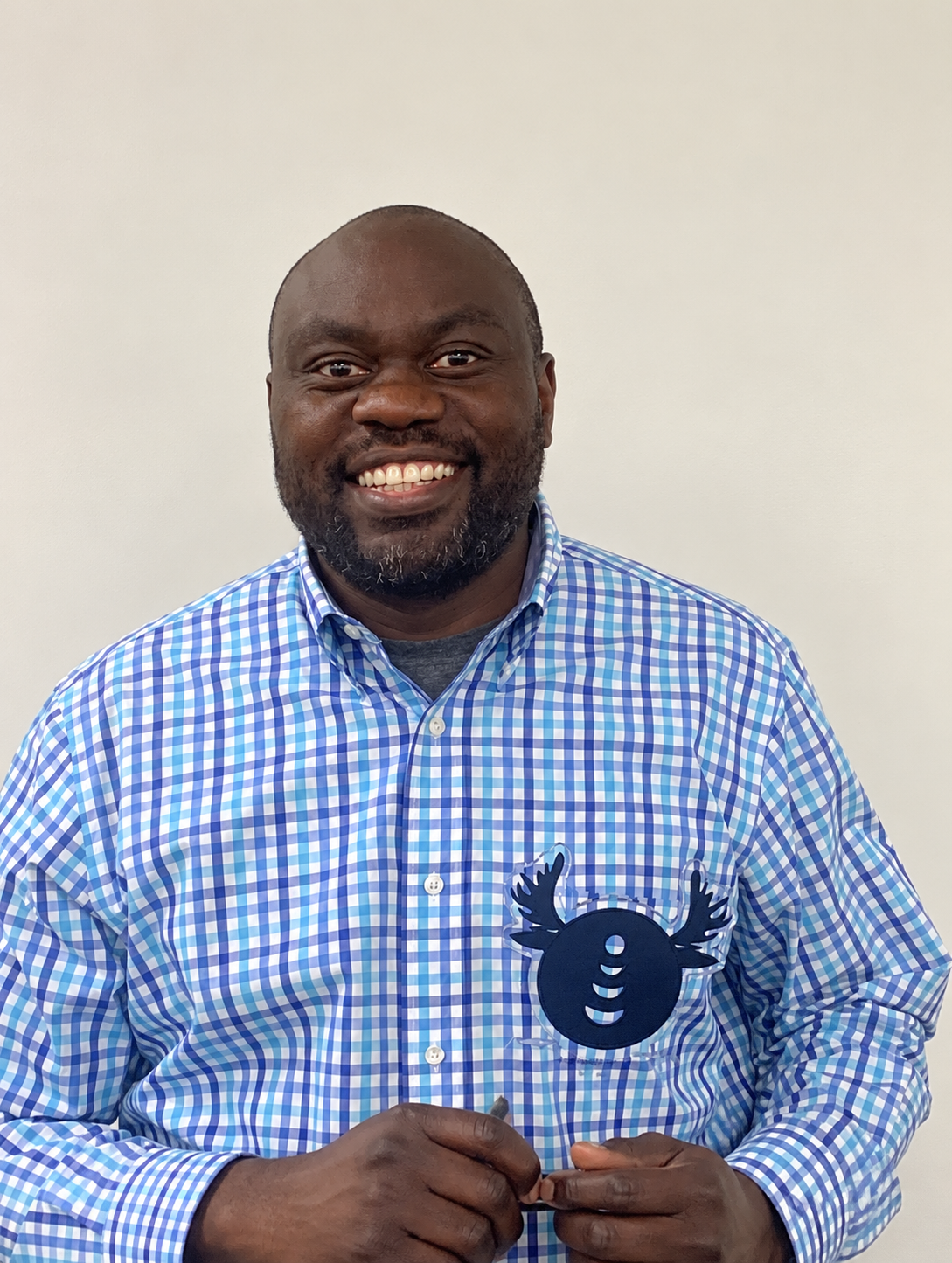
Fredrick Odero
Tau Wireless was founded by Fredrick Odero, an RF and wireless systems engineer with more than 15 years of experience working with wireless technologies spanning 3G, 4G, 5G, Open RAN, distributed antenna systems and public-safety wireless communications.
Throughout his career, Fredrick has worked with radio systems not merely as mathematical abstractions, but as real engineering systems that must be designed, deployed, measured, troubleshot and made to work.
That experience shaped the philosophy behind Tau Wireless. Many difficult RF and DSP concepts become considerably more approachable once a learner can see what the mathematics is describing.
A constellation shouldn't just be a diagram in a textbook. You should be able to generate one. Carrier-frequency offset shouldn't just be an equation. You should be able to introduce it and watch the constellation rotate. Multipath shouldn't simply be another channel model. You should be able to change the channel and observe what happens to the radio.
And OFDM shouldn't begin as a collection of FFTs, cyclic prefixes and subcarriers to memorize. Students should first understand the engineering problems that caused those techniques to exist.
That philosophy has also shaped Fredrick's hands-on teaching in the SDR community. At GNU Radio Conference 2026, he led a two-hour workshop in which participants built an over-the-air OFDM transceiver using software-defined radios and were exchanging messages between stations during the session.
Why I teach radio this way
I created Tau Wireless around the way I believe engineering is best learned: develop the intuition, experiment with the system, and then use the mathematics to explain what you observe.
I don't want students simply memorizing modulation schemes, block diagrams or equations. I want them asking questions.
What happens if I change this? Why did the signal do that? What problem is this block solving? Can I build it? Can I break it? Can I figure out a radio I've never seen before?
If you finish a Tau Wireless course asking better engineering questions than when you started, we're doing something right.
Learn by doing. Build intuition first.
— Fredrick Odero
Founder, Tau Wireless
Develop capability, not just course credits.
Tau Wireless isn't designed around collecting courses. It's designed around developing capability.
After completing the core journey, students put those skills together in CTS — Capture the Signal.
No recipe. No step-by-step flowgraph. Just a signal and the tools and intuition you've developed to figure it out.
The goal isn't simply to know more about radios. It's to be able to do something with what you know.